


There was a season in my life when I could barely catch my breath.
I was in the middle of my discernment process for ordination as a deacon. That alone is a lot. But everything around it was full of anxiety and stress too… the kind of big life challenges that keep you up at night and follow you around all day.
During that season, I started praying the Daily Office from the Book of Common Prayer. Morning Prayer. Evening Prayer. The Psalms, the Scripture readings, and the ancient prayers of the Church.
And something shifted.
On the days I was consistent with it, my mind and my heart got set right. I found a peace that didn’t depend on how the day was going. It helped me feel like I could actually breathe, and like I could actually get through whatever was in front of me.
The problem? Consistency.
I even confessed this in my book, Holy Rhythms for Hurting Hearts. I love the Daily Office, but I could certainly be more consistent with it. Praying it usually meant having my prayer book with me and carving out 20 to 30 minutes. Some days that happened. A lot of days it didn’t.
And the days I needed it most were usually the days I had the least time.
why a daily prayer routine is so hard to keep
I have a feeling I’m not the only one who’s been there.
You decide this is the time you’re finally going to build a real prayer life. Quiet time every morning. A journal. Maybe a new devotional book. The first week goes great. Then there’s a busy Tuesday. Then a sick kid. Then a week of travel. And by the end of the month, the whole thing has quietly fallen apart… and you feel a little guilty every time you think about it.
I don’t think that’s a willpower problem. I think it’s usually one of a few things.
It feels all-or-nothing. If you can’t do the full thing, it doesn’t feel like it counts. So on the busy days, you do nothing at all.
It takes stuff and time you don’t always have. The right book, a quiet room, and a solid half hour aren’t always available on a Wednesday at noon.
The tools meant to help can add pressure. A lot of prayer apps try to solve consistency with reminders. Ding… time to pray! But that ding rarely shows up at a convenient moment. It comes in the middle of a meeting, in traffic, or in the middle of a hard conversation with your kid. So instead of an invitation, it becomes one more thing you didn’t do.
Prayer was never meant to be one more thing to feel guilty about. And as it turns out, the Church figured out a better way a very long time ago.
fixed hour prayer: a rhythm older than any denomination
God’s people have been praying at set times through the day for thousands of years. It’s often called fixed hour prayer, or praying the hours.
You can see it all through Scripture. The psalmist cries out to God evening, morning, and noon (Psalm 55:17). Daniel kneels to pray three times a day, even when it could cost him his life (Daniel 6:10). Peter and John head to the temple at the hour of prayer (Acts 3:1). And Peter goes up on a rooftop to pray around noon (Acts 10:9).
The early Church carried that rhythm forward. Monastic communities built their entire day around it. In the sixth century, St. Benedict’s Rule had monks gathering to pray eight times a day, with the Psalms woven all the way through.
Most of us aren’t monks. (I’m definitely not.) But when Thomas Cranmer put together the first English Book of Common Prayer, he took those monastic hours and shaped them into a rhythm ordinary people could actually live with. That same heartbeat still runs through the Book of Common Prayer today, with Morning Prayer, Noonday Prayer, Evening Prayer, and Compline.
And if you’re Catholic, this will feel familiar. It’s the same family of prayer as the Liturgy of the Hours.
What captured me most was the Benedictine idea of multiple touch points through the day. Not one big block of prayer that has to go perfectly, but small moments scattered throughout the day that keep pulling your heart back toward God.
four short prayers, from morning to night
Tucked into the Book of Common Prayer, right after the fuller Daily Office services, is a little section called Daily Devotions for Individuals and Families (starting on p. 136).
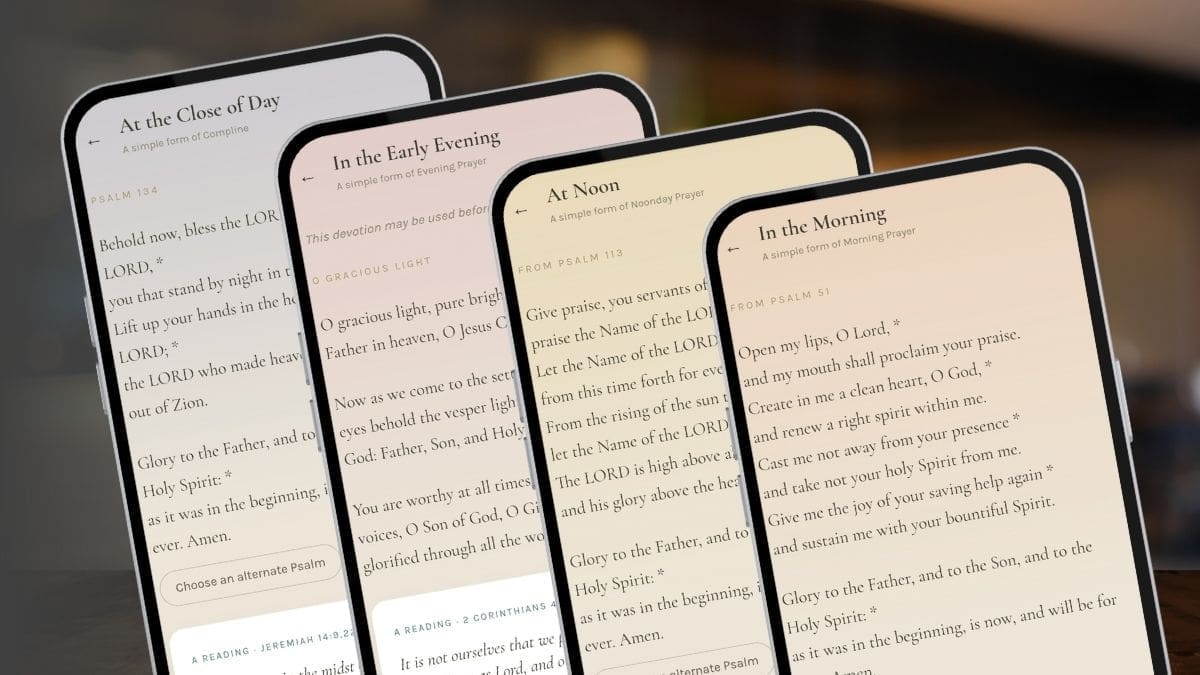
These four devotions follow the same basic shape as the Daily Office, just shorter, and made for personal and household use. There’s one for the morning, one at noon, one in the early evening, and one at the close of day. Each one has a Psalm, a short Scripture reading, and a few prayers. You can pray any of them in just a few minutes.
And here’s the thing I didn’t expect. When you pray the same words day after day, some of them become like old friends. I’ve found a little something in each of the four that I genuinely look forward to… a word or phrase that brings me right back to the presence of God.
In the Morning
The morning prayer opens with words from Psalm 51:
Create in me a clean heart, O God, and renew a right spirit within me.
Every time I pray it, it feels like I’m receiving His promise of something fresh at the start of each new day. Whatever yesterday was, today gets a clean heart.
At Noon
The noon prayer includes this short reading from Isaiah:
O God, you will keep in perfect peace those whose minds are fixed on you…
This one always brings me right back to why I keep showing up. The practice helps me keep my mind fixed on Him in the middle of a busy day. And His peace comes with that? Awesome.
In the Early Evening
The early evening prayer closes with a collect that begins:
Lord Jesus, stay with us, for evening is at hand and the day is past…
As my day shifts and other things start coming to an end, this reminds me that He’s still with me. His presence is the constant, even when everything else is winding down. That’s incredibly comforting.
At the Close of Day
The last prayer of the day is a short form of Compline, the Church’s ancient bedtime prayer, prayed before sleep for centuries. Its closing collect begins:
Visit this place, O Lord, and drive far from it all snares of the enemy; let your holy angels dwell with us to preserve us in peace…
As I get ready to lay down to sleep, this reminds me that His provision and protection are with me even while I’m sleeping. I don’t have to worry about what I can’t control while I’m not awake. He’s got me covered all night long.
you don’t have to be Episcopalian to pray this way
If you’re Episcopalian or Anglican, these prayers will feel familiar. You probably know the fuller versions of the Daily Office well. These shorter forms just make that rhythm easier to reach… especially when you’re not carrying a prayer book everywhere you go.
But if you come from a non-liturgical church, let me speak to you for a minute. I spent years in charismatic, non-denominational churches before I found my way into the Episcopal Church. So I understand if words like “liturgy” and “written prayers” sound a little stiff.
On the surface, liturgical prayer can look mechanical and repetitive. But when you dig in, you find something rich and deeply personal.
It’s Scripture-led prayer. These devotions are built on the Psalms and the Word of God. You’re praying the same words God’s people have prayed for centuries. And on the days you don’t have your own words, they give you some.
It makes room for your own prayers. Each devotion has a place where you can offer prayers for the people and needs on your heart. Your friend who’s sick. Your kid who’s struggling. That decision you can’t stop thinking about. Your words can be as long or as short as you need them to be.
That’s where the beauty is. The written prayers give you a solid place to stand, and your own prayers make it yours. It’s structure and freedom working together, not one or the other.
The Rhythm: a praying the hours app for real life
I wanted these prayers with me wherever I was. No extra book to carry. No 30-minute block to protect. Just a way to open them up in a few spare minutes, and make the time as big or as simple as the day allowed.
So I built one.
The Rhythm is a free app that brings the four Daily Devotions from the Book of Common Prayer to your phone. You can try it free right now, and you don’t even need an account to pray whatever prayer fits this moment.
Here’s how it works.
open it and it’s ready for right now
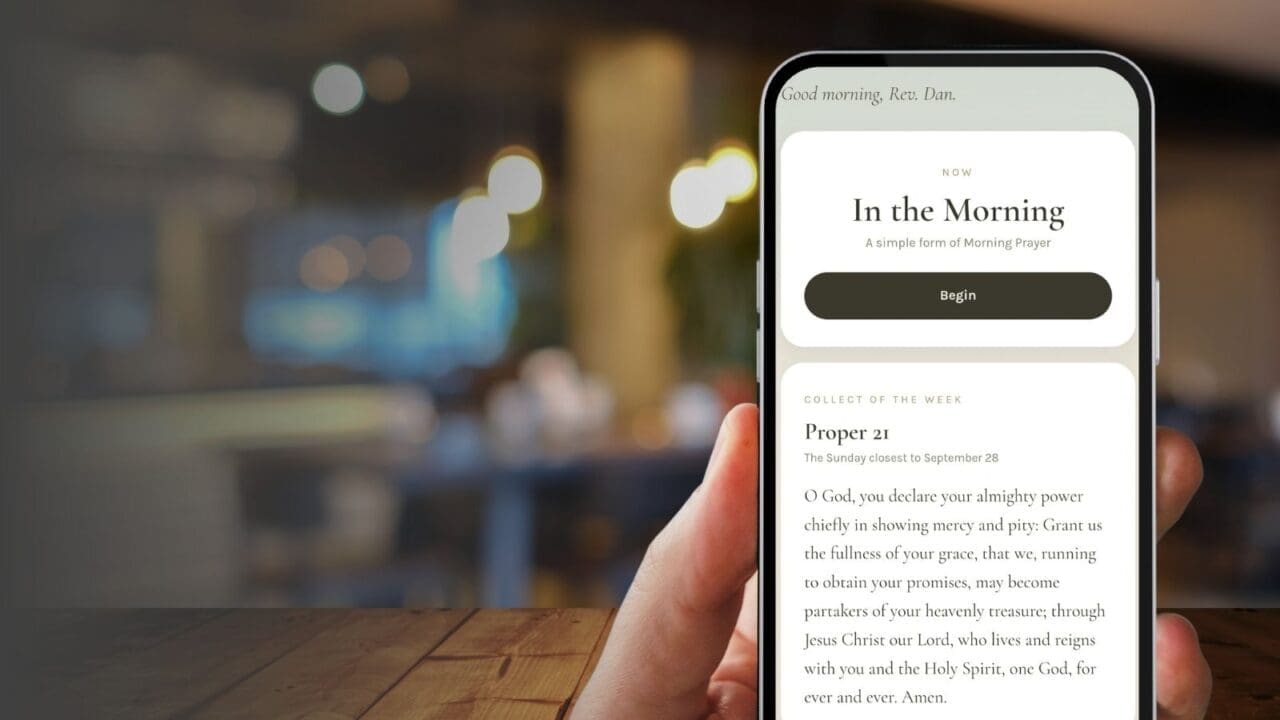
The Today page has a “Now” card that opens whichever prayer fits the time of day. Morning? It’s ready. Lunch break? Noon is waiting.
The Today page also shows the Collect of the Day or Week, which follows the Church year, Holy Days included. So as the seasons of the Church move from Advent to Lent to Easter and beyond, your daily prayers move right along with them.
pray, then say Amen
Each prayer is the text from the Book of Common Prayer, word for word, with its Psalm, short reading, and prayers. Nothing is paraphrased or “improved.”
When you finish, you tap Amen.
see your rhythm take root
Tapping Amen records that you prayed. Over time, “Your rhythm” shows how many days you’ve prayed this week and in all.
It’s a quiet picture of a practice taking root. There are no streaks to protect, and missed days are never counted against you. And if you pray Compline late, it still counts for that evening. (A “prayer day” runs until 3 a.m.)
The goal is peace, not pressure.

82 more prayers and thanksgivings for whatever the day brings
Life doesn’t always fit into four time slots. So The Rhythm also includes a Library of 82 prayers and thanksgivings from the Book of Common Prayer, organized into 13 sections for particular needs and occasions. When something comes up that you want to bring to God, there’s probably a prayer for it.
it goes where you go
The Rhythm is a web app, so it works right from your phone’s browser. You can install it to your home screen and it works just like any other app, with no app store required.
The prayers still open when you don’t have a signal. And signing in uses a one-time code sent to your email, so there’s no password to remember.
why The Rhythm will never ding at you
Ding… you have a new email. Ding… someone liked your post. Ding… a score update for your favorite team.
Our phones are always summoning us. And every ding pulls our attention away from wherever we actually are. I wrote a whole chapter about this in Holy Rhythms for Hurting Hearts, about how ancient practices of stillness can help us put our devices back in their proper place.
So I made a deliberate choice. The Rhythm has no notifications and no reminders. None.
A ding telling you it’s time to pray almost never comes at a good moment. And when you can’t stop to pray right then, the reminder doesn’t draw you closer to God. It just leaves you feeling guilty. That’s the opposite of what I want this to be.
The Rhythm is an invitation, not an obligation. It’s there when you come to it, on your own timing.
And here’s what surprised me. Without anything nudging me, I’ve started to genuinely miss it when the day crowds one of the prayers out. Not guilt… just a little longing. I want to get back to those words that remind me I’m not alone.
That’s the kind of motivation that actually lasts.
building a rule of life, one prayer at a time
A rule of life is a simple set of rhythms that shape how you live… how you pray, rest, work, and love the people around you. The idea goes back to St. Benedict, but it isn’t about rigid rules or legalism.
As I put it in the book, it’s not about guilt. It’s about guidance.
A daily rhythm of prayer is one of the best places to start a rule of life. And the best way to start is small. Here’s what I’d suggest:
- Go to therhythm.bibledude.life and pray whatever prayer is up right now. No account needed.
- Create a free account. That opens up all four prayers and the full Library.
- Install it on your phone so it’s one tap away.
- Pick one prayer, not four. Maybe it’s the morning prayer with your coffee, or Compline before bed. Pray that same one for a week.
- Add another when you’re ready. Let the rhythm grow at its own pace.
One of the first people to try The Rhythm told me it was incredibly easy to use and that they loved it. That’s exactly what I hoped for. Something simple enough to pick up on any ordinary day, and deep enough to keep coming back to.

free to pray, with ways to go deeper
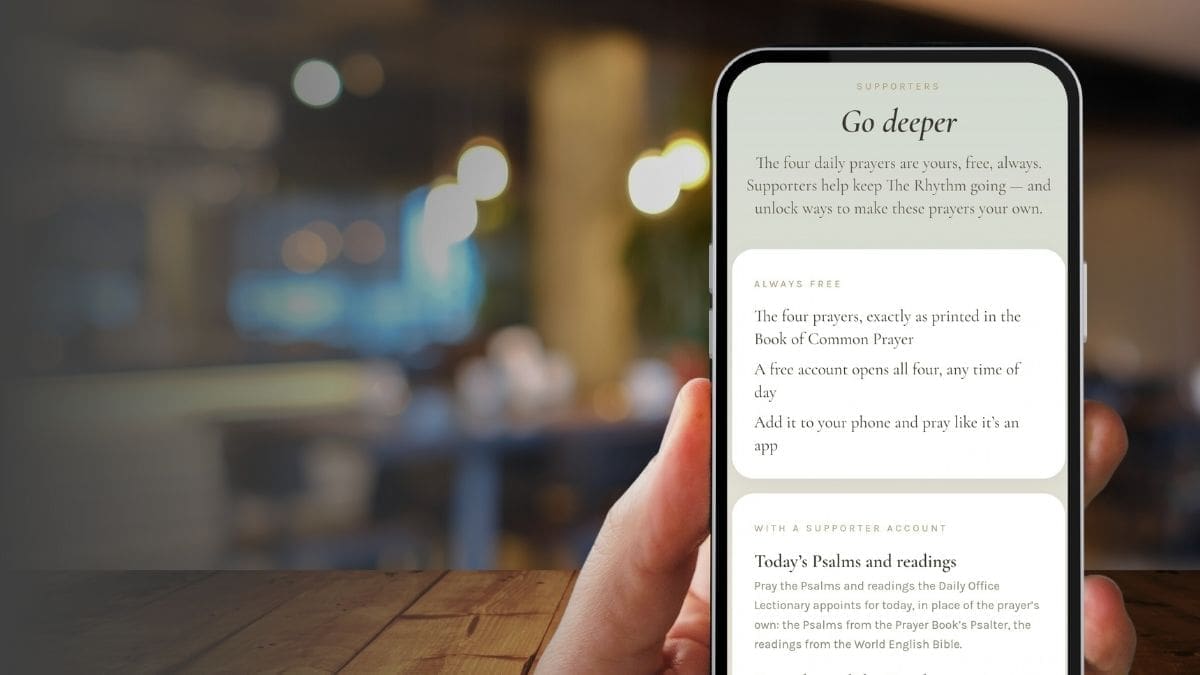
The heart of The Rhythm is free, and it always will be. Create a free account and you get all four daily prayers exactly as printed, the full Library, the collects, your rhythm, and the ability to install it on your phone.
For those who want to go deeper, paid levels start at just $3 a month and unlock some really nice premium features:
- Today’s Psalms and readings. Swap in the Psalms and readings appointed for that day in the Daily Office Lectionary.
- Canticles and the Creed. In the morning, pray one of the canticles from the Book of Common Prayer or the Apostles’ Creed.
- My Prayers. Keep a list of the people and needs you’re praying for, and they’ll show up automatically where each prayer invites your own prayers.
- A quiet place for notes. Write what’s on your heart after you pray. Your notes are private and searchable.
This is how you can make your time as big as you want. And it helps keep the core of The Rhythm free for everyone else.
frequently asked questions
How long does each prayer take?
As long or as short as you need. Each core prayer can be prayed in about 2 to 4 minutes. Adding the day’s Psalms and readings, or your own prayers, can stretch that out as much as you want. You can pray one in 3 minutes while waiting in line, or spend 30 minutes going deeper. Or use 5 to 10 minutes as a foundation that launches you into a longer time of personal prayer and reflection.
Do I have to pray all four prayers every day?
Not at all. Start with one. Many people find one or two prayers a day is a beautiful rhythm. Add more whenever you’re ready.
Do I need to be Episcopalian or Anglican?
No. These prayers come from the Book of Common Prayer, but they’re built on Scripture and the Psalms, and they’re shaped by a rhythm of prayer that’s centuries older than any denomination. Christians from any tradition can pray them.
Is this the same as the Liturgy of the Hours?
It’s part of the same family. The Liturgy of the Hours is the Catholic form of praying the hours. The Rhythm uses the shorter Daily Devotions from the Episcopal Book of Common Prayer, which follow the same ancient pattern of praying at set times through the day.
What is Compline?
Compline is the Church’s traditional prayer at the close of the day, prayed just before sleep. The Rhythm’s final prayer, At the Close of Day, is a short form of Compline.
Is The Rhythm really free?
Yes. The four prayers, the Library, the collects, and your rhythm are always free. Paid levels starting at $3 a month add extra features for going deeper.
Which Bible translation does it use?
The Psalms come from the Psalter in the Book of Common Prayer, and the readings use the World English Bible, a modern public-domain translation. More translations are planned.
Is The Rhythm in the app stores?
Not right now. It’s a web app, so you open it in your phone’s browser and install it to your home screen. Once installed, it works just like any other app.
What happens if I miss a prayer or a whole day?
Nothing at all. Missed days are never counted against you. Just come back whenever you’re ready.
finding your rhythm
I started praying these prayers because I needed to breathe. And somewhere along the way, they became the places in my day where I’m reminded that I’m not alone. A clean heart in the morning. Perfect peace at noon. His presence as the day winds down. His protection through the night.
You don’t have to overhaul your whole life to find that kind of peace. You don’t need a perfect morning routine or an hour of quiet. You just need a few minutes, a few ancient words, and a willingness to show up.
Healing rarely happens all at once. But it does come, one sacred rhythm at a time.
Start praying with The Rhythm at therhythm.bibledude.life.
The Rhythm is a free prayer app from BibleDude.life and a companion to Holy Rhythms for Hurting Hearts. Questions? Reach out to me here.

0 Comments