
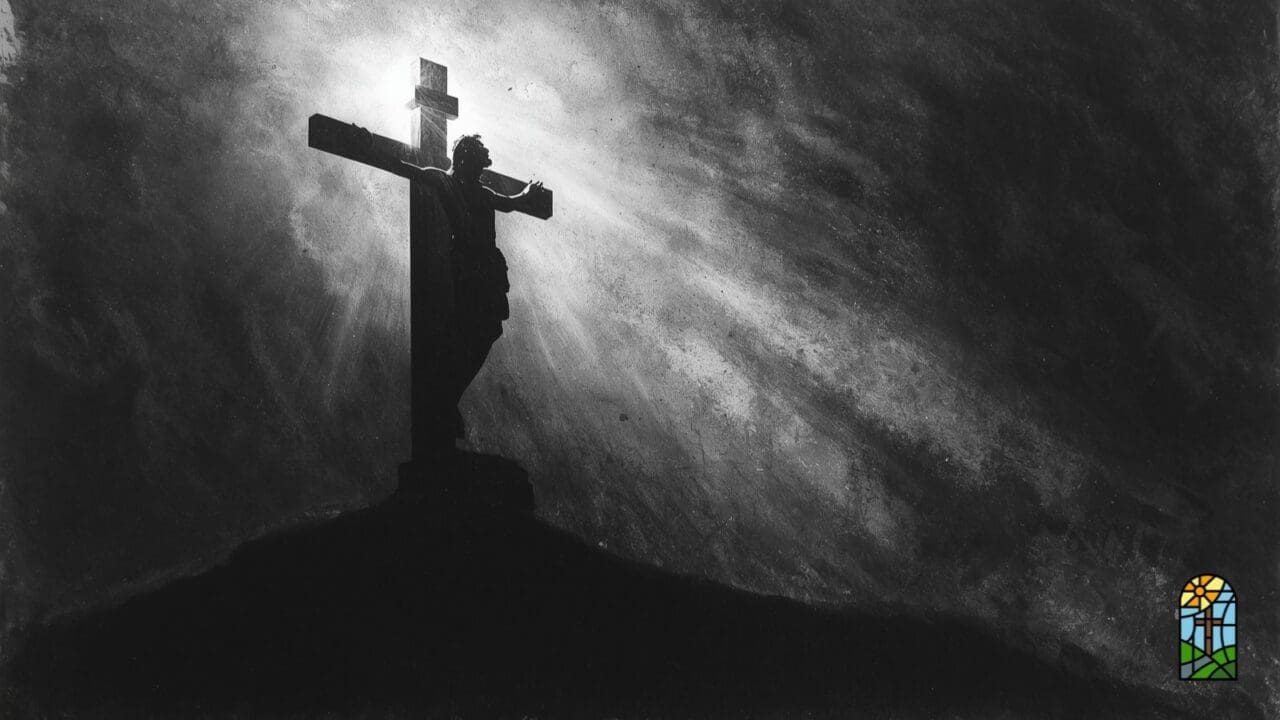

It’s about three o’clock in the afternoon. A darkness has covered the whole land since noon. Jesus had been beaten, stripped, nailed to the cross, all while being mocked.
Each taunt a jab at his identity… “If you are the Son of God…”
The religious leaders, bystanders, and even the criminals crucified next to him all threw insults at Him.
And it was at that moment when He cried out with a loud voice…
“Eloi, Eloi, lema sabachthani?”
Which means, “My God, my God, why have you forsaken me?”
This isn’t the first time these words show up. It’s the opening line of Psalm 22, a plea for deliverance from suffering and hostility.
In His darkest moment, Jesus reached for His prayer book.
And while the words he shared were few, those who were there — His followers, the religious leaders who put Him on that cross, those passing by — they would have recognized that line immediately.
In Jewish practice in that time, quoting the opening line of a Psalm like that was understood to invoke the entire Psalm.
By verse 24, it gets to…
“For he did not despise or abhor the affliction of the afflicted; he did not hide his face from me, but he heard when I cried to him.”
And by the end it becomes a song of praise and proclamation to future generations.
This cry… It’s not a failure of faith. It’s actually faith in its most honest and raw form.
Even in the feeling of desperation and aloneness, he still says, “My God.”
He’s not renouncing the relationship, He’s leaning into it.
Martin Luther had a word he used for this feeling of suffering. He called it Anfechtung. It’s something like “spiritual assault” or “the terror of feeling Godforsaken.” It’s something he’s experienced many times throughout his life.
I remember a time in my life when I felt abandoned.
My first son was 17-months old. And the day after my second Father’s Day, we took him to the doctor where we received a Type 1 Diabetes diagnosis. It rocked us to the very core of our being.
At first, I had to be the strong one. I didn’t have time to process. Someone had to stay clear-minded enough to drive us to and from doctors and hospitals and eventually get us all home.
A day or so after getting settled back in at home, my wife and son were both napping. I stood in our kitchen, and something inside me just broke. Every feeling, fear, and sense of despair flooded in all at once.
Anfechtung.
I dropped to the floor, and sat there in the fetal position, just crying.
At first, it was hard enough to even breathe under the pressure of it all. And then the words came out, almost involuntarily…
Why, God?
And in that cry, I couldn’t feel Him near me at all. But I still cried out to Him.
And I’ve wondered since then… was God actually there? Could He have been?
In the third century, Origen explores this idea, pointing out that the forsakenness that Jesus experienced was real in its felt quality, but was not a metaphysical rupture.
In other words, he understands that the eternal union between the Son and the Father could never be severed. So Jesus was never alone in that moment, even when He felt otherwise.
Origen says that Jesus entered the full human experience of spiritual desolation so that humans might never have to face it alone.
I’ll say that again… So that we will never have to face it alone.
And that’s where Jesus is.
Hanging on that cross, taking on the weight of the sin of the whole world, carrying unimaginable pain, and feeling abandoned.
Anfechtung.
He cries out, “My God.”
The relationship holds, even when the feeling doesn’t. When everything else is stripped away, there’s still “my God.”
And that’s what faith looks like sometimes.
No certainty that everything is going to be okay.
No comfort.
Just a voice in the dark, aimed at God.
That day, as I sat completely broken on my kitchen floor, I couldn’t imagine what the next day — the next moment — would look like.
And as I look back on one of the hardest days of my life, I can see now what I couldn’t see then.
He was with me.
Huddled next to me in the fetal position, crying with me…
“Eloi, Eloi, lema sabachthani?”
—
Note: This was written as a reflection for a Good Friday service at St. Edward’s Episcopal Church called “The Seven Last Words” reflecting on the seven last statements of Jesus before He died on the Cross.
0 Comments