

the readings:
the sermon:
I got the Eucharist schedule from Father Mark, and I saw this week was Trinity Sunday, then looked in the “sermon” column and had my name there, and my initial reaction was…
*GRUNT* … How can I get the live feed to (air quotes) “not work?” Because I knew that trying to explain the Trinity would probably result in me preaching some kind of heresy.
In fact, I just saw a meme that said, “How not to commit heresy preaching on the Trinity… Say nothing and show pictures of kittens instead.”
Then as I was preparing and digging through the readings, I started to realize that it’s not so much a doctrine to explain, but simply sharing who God has always been and what that means for us.
The Triune God is unique. And not just in what He does, but also in what He is before doing anything at all.
So let’s go back to the beginning…
who God is before anything exists
Genesis 1 starts it off by saying:
“In the beginning when God created…”
I’ll stop right there for a moment. I love getting into the original language grammar, because it always shows some fascinating stuff. Check this out…
God here is Elohim, which is one of the primary names for God in the Old Testament. But grammatically, it’s plural.
But here in this opening statement the verb for created, which is bara, is used in the singular.
The more than one, acting in a singular way. I don’t want to overly read into this, but even before Creation, this points to One God, but not simple in nature.
Let’s jump ahead to verse 26 where it says:
“Then God (Elohim) said, ‘Let us make humankind in our image, according to our likeness…’”
Even ancient Hebrew scholars have debated the use of the plural in this verse for thousands of years, many referring to it as a “royal we” or some kind of divine council. But through the lens of Christian reading and canonical witness, it’s easy to hear the relational nature of the Triune God speaking from within itself.
This is actually one of the things that makes the Christian faith different. Many in our culture would say, “Don’t all gods just point to the same God?”
I would argue that they don’t.
Listen… Before anything existed, love already did.
The Triune God wasn’t lonely.
Wasn’t incomplete.
Wasn’t creating in order to have someone to love.
God was already, in His very nature, a community of self-giving love.
Creation doesn’t fulfill God.
Creation expresses God.
This is what makes the Christian God unique. Other monotheistic concepts of God create out of need or will. They create in order to find love.
The Triune God creates out of overflow.
And it’s this God, the One who spoke everything else into existence, said “let us make,” and then reached into the dirt with both hands and crafted us.
The word used for that act is yatsar, which is like a potter shaping clay. It’s more like an artisan at work with intentionality and care.
And then He breathes life into us through our nostrils… breath… the same word used in verse 2 talking about the wind, or the Spirit, of God moving over the face of the waters.
This says a great deal about God and His nature. But it also says a lot about us. Created in His image, we are a living declaration of the presence and character of God in the world.
And that changes everything about how we understand ourselves.
the parenting bridge
I have to say, I think I’ve learned more about God by becoming a parent than anything else I’ve ever experienced.
I remember the day my first child was born. Going into the day, I thought I knew what love was. But I was not ready for how this would impact me.
After all the preparation and waiting and anticipation, Samuel arrived. The nurses take him, clean him up a little bit, and then lay him down in (I don’t know what it’s called, I just always call it) the french fry warmer. He’s just laying there crying, screaming actually.
I asked the nurse if I could touch him. She said, “absolutely.” So I leaned down to him, gently touched his head, and said to him, “It’s okay Samuel, daddy’s here.”
And instantly, he stopped crying and turned his head towards the sound of my voice.
From that moment. I think we both knew that everything was going to be different.
He’s 23 now.
And over the years, we’ve laughed together.
We’ve cried together.
We’ve been mad at each other.
And we’ve had the best of times together.
Now he’s a man. Building his own life. Doing his thing.
And I couldn’t be more proud of him.
And that’s pretty much what we see God doing in Genesis 1. Making mankind in His image, and sending them into the world as bearers of that image.
And if you know Samuel, then you know that he certainly bears my image. Krista looks at the two of us and says (*snipping motion*), “cut from the same cloth.”
But you know what’s awesome? I hear the same thing regularly about even my adopted kids. From time to time, someone will say something to me like, “Man, Andrew totally has your sense of humor!”
Image-bearing goes much deeper than just appearance. It’s that sense of humor. It’s the way we approach the world.
It’s not only biological. It’s relational. It’s formed through love and time and presence.
So when Genesis says we’re made in the image of God, it’s more than resemblance. It’s describing a relationship. A belonging.
what is man that You are mindful of him?
We struggle to get this sometimes, though, don’t we?
In our Psalm today, we even see David asking the question:
“What is man that you should be mindful of him?”
It’s a big question! Why does a God who is already complete in love, who spoke galaxies into existence, bend towards these small, dust-formed creatures with such attention?
The answer isn’t found in us. It’s found in God. It’s simply who God is.
God moves toward.
God attends.
God notices.
But belonging to a God like that doesn’t just make you feel secure in who you are. It eventually sends you somewhere.
the sending
And that brings us to our Gospel reading in Matthew 28.
Eleven disciples standing on a mountain in Galilee. In Matthew’s Gospel, mountains are where heaven and earth meet.
And in that place, it says that some doubted. These are the resurrection witnesses! They’ve seen the risen Christ. Yet some are still doubting.
But Jesus doesn’t address or correct it. He commissions them anyway.
He commissions the doubters.
He sends the uncertain.
Listen, if you’re sitting here today, and maybe you love God, but you can’t get to certainty, take note. The mission doesn’t require resolved doubt. It only requires showing up.
Then before the commission, Jesus gives us a declaration:
“All authority in heaven and earth has been given to me.”
When Jesus sends us out, it’s not going out under our own authority. It’s under the authority of the One who made you, formed you, breathed life into you.
This echoes the dominion given to image-bearers in Genesis 1:28. It’s the renewal of the original vocation.
Then Jesus sends out to all nations, saying:
“Baptizing them in the name of the Father and of the Son and of the Holy Spirit.”
This is the only explicit Trinitarian formula in the Gospels, and it’s not in a creed, but in a commission.
The Trinity isn’t given to us as a puzzle to solve. It’s given as the name we go in. The name of Love that existed before anything else.
And in the original language, it means more literally that we are baptized into the name. In other words, baptism is an entrance into the relational life of the Triune God.
Then the most beautiful thing happens.
The commission doesn’t end with a task. It ends with a promise. Jesus says:
“And remember, I am with you always, to the end of the age.”
The God who hovered over the waters, who got in the dirt, who breathed life into dust, who stood on a mountain with doubting friends, says: I’m not sending you away from me. I’m sending you with me.
This is fascinating. I think we often treat the Great Commission like a recruitment drive. But Jesus frames it as something far more like what we just watched God do in Genesis. It’s not about adding numbers. It’s about extending love.
We’re doing the same thing God has done from the very beginning… extending this amazing Love to every corner of the earth.
into ordinary time
This is Trinity Sunday. It’s like the great kick-off party for the long green season.
Ordinary time.
And if we’re honest, it’s anything but ordinary! It’s the season in our liturgical calendar when the Church stops looking at the life of Christ and starts living out the life of the Church.
It’s the season where the story shifts from what God did to what God’s people do.
And that’s exactly what Matthew 28 is about. The Triune God who existed in love before creation, who crafted humanity with intention and intimacy, who commissioned doubters on a mountain in Galilee, is now sending us.
Into our neighborhoods.
Our workplaces.
Our families.
Sending us to be love, and to extend love in all those places.
Paul, near the end of his second letter to the Corinthians, after walking a messy and complicated congregation through some of the hardest things they’d ever faced, doesn’t end with a to-do list. He ends with a blessing that sounds a lot like the blessing we get at the end of the Eucharist. A blessing that is also, in its own way, a commission.
“The grace of the Lord Jesus Christ, the love of God, and the communion of the Holy Spirit be with all of you.”
Paul doesn’t explain the Trinity. He blesses people with it. And then he sends them.
So consider yourself blessed.
And consider yourself sent.
Amen.
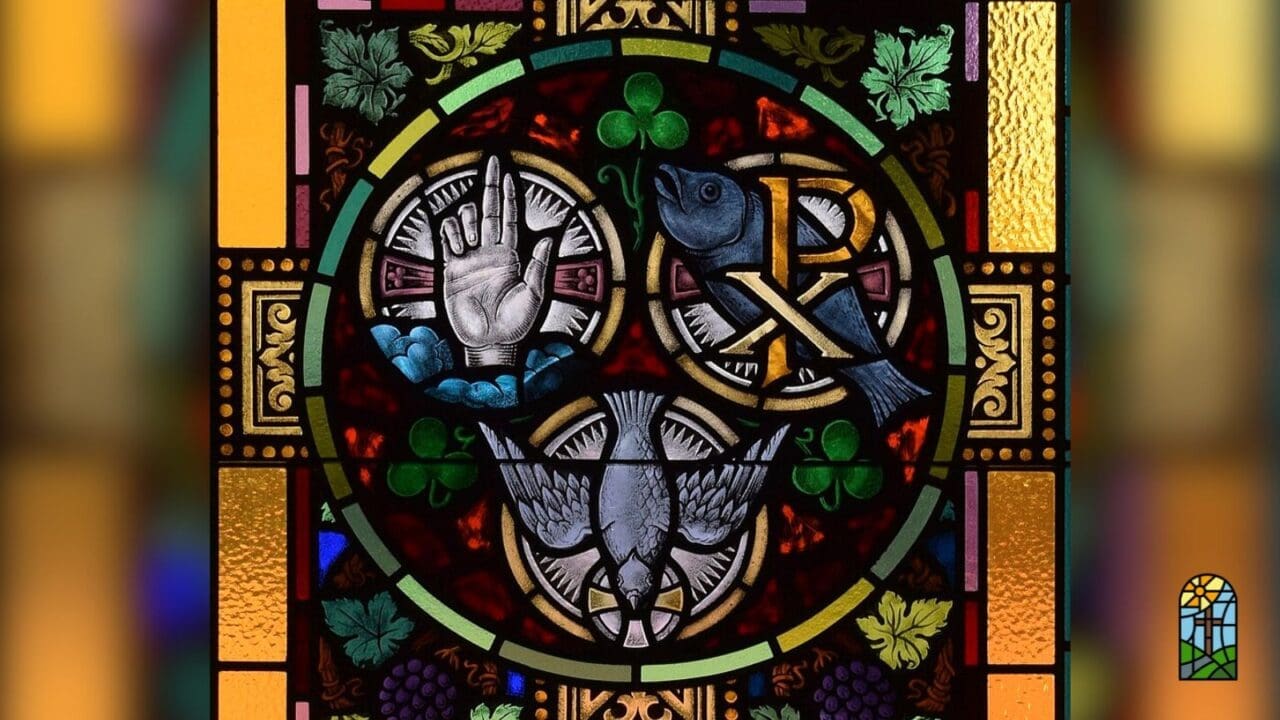
Image: Our Lady of the Rosary Shrine at Saint Patrick Church (Merlin, Ontario) – stained glass, church nave, Symbols of the Persons of the Trinity, used via Creative Commons.

0 Comments