

the reading:
It is a credit to you if, being aware of God, you endure pain while suffering unjustly. If you endure when you are beaten for doing wrong, what credit is that? But if you endure when you do right and suffer for it, you have God’s approval. For to this you have been called, because Christ also suffered for you, leaving you an example, so that you should follow in his steps.
“He committed no sin,
and no deceit was found in his mouth.”When he was abused, he did not return abuse; when he suffered, he did not threaten; but he entrusted himself to the one who judges justly. He himself bore our sins in his body on the cross, so that, free from sins, we might live for righteousness; by his wounds you have been healed. For you were going astray like sheep, but now you have returned to the shepherd and guardian of your souls.
the sermon:
I remember a time when I worked in the corporate world when I felt like I was doing all the right things, but I still got the short end of the stick.
I worked hard, earned the respect of my peers, and always looked for ways to improve how we worked. And when a certain promotion came up, everyone who knew me assured me that I was by far the most qualified, and that I was a shoo-in for the role.
Someone else got it.
In fact, what I got was a trip to the corporate office (where my boss worked) so that he could tell me, “Dan, I know you love your family and all, but don’t let that get in the way of your career. You really do have a lot to offer.”
I was dumbfounded. I’d tried to be a genuine bright spot everywhere I went, and apparently that was exactly the problem.
Has anyone else ever been told, in one way or another, that who you are is the obstacle?
the world peter is writing into
Now, I want to be careful here. My story is one of frustration and disappointment. What Peter is writing to is something considerably harder.
In our reading today from Peter’s letter to the Church scattered across Asia Minor, likely written during the reign of Nero, Christians faced real hostility, real social rupture, and in some cases, very real persecution.
Rome called them atheists, not because they had no faith, but because their faith had no idol Rome could recognize.
And in those times, there was a code people followed. Peter is specifically speaking to the Haustafel, the Greco-Roman household structure for organizing social ethics. In this structure, it was the paterfamilias, usually the oldest living male, who had absolute legal authority over the extended household.
Peter works through this structure deliberately: governing authorities, then servants, then wives and husbands. He’s not skipping around. He’s moving through the architecture of daily life.
So when someone converted to Christianity without the paterfamilias converting, they were stepping outside the household’s religious identity. That’s not a small thing. That’s social rupture.
Peter isn’t endorsing this system. He’s speaking pastorally into this situation that his readers can’t immediately change.
charis and the two kinds of suffering
Into this structure, Peter starts by talking to the household servants, saying:
“It is a credit to you if, being aware of God, you endure pain while suffering unjustly. If you endure when you are beaten for doing wrong, what credit is that? But if you endure when you do right and suffer for it, you have God’s approval.”
Pay attention to what’s happening here. The term often translated here as “a credit” or “commendable” is charis, in the original Greek. It’s accurate, but it really loses something significant. Throughout the rest of the New Testament, it’s the primary word for grace. And Peter uses it twice here, bracketing this whole instruction.
Listen to me. He’s not saying that suffering is good. He’s saying that God doesn’t abandon you inside it.
The grace is not in the suffering itself. It’s in who is present with you in it.
And he’s even calling out the idea of enduring suffering when you do wrong.
Sometimes, our suffering is something that happens because of our own choices or sin. That’s consequence. That’s the natural weight of our own choices.
What Peter is saying here is that suffering that comes from doing good, from living as a Christian, that carries charis. Grace is present and active within it.
Enduring unjust suffering while keeping your eyes on God isn’t just admirable behavior. It’s walking in something divinely graced.
called, hypogrammos, and paradidomi
“For to this you have been called…”
…Peter writes in verse 21. I love that he used that word, called.
When I began my discernment process for eventually being ordained as a deacon in the church, there were several levels of ensuring that I and the church were certain about my calling.
And Peter is using that same idea here, but not just for ordained people. He’s writing to household servants when he talks about calling.
Open a Book of Common Prayer to page 855.
This is from our Outline of the Faith (commonly called the Catechism). There’s a question and answer there that I want us to look at together.
Q. Who are the ministers of the Church?
A. The ministers of the Church are the lay persons, bishops, priests, and deacons.
In my training, I learned that with everything in the Book of Common Prayer, order is important. If there is a list of things, the first one in the list is the ideal option. So notice that in our Outline of the Faith, the first ones listed as the ministers of the Church are the lay persons.
Peter is speaking to this idea. He’s recognizing that the way we live our lives is a ministry to the people around us.
And here’s my favorite part of this. Peter writes:
“…because Christ also suffered for you, leaving you an example, so that you should follow in his steps.”
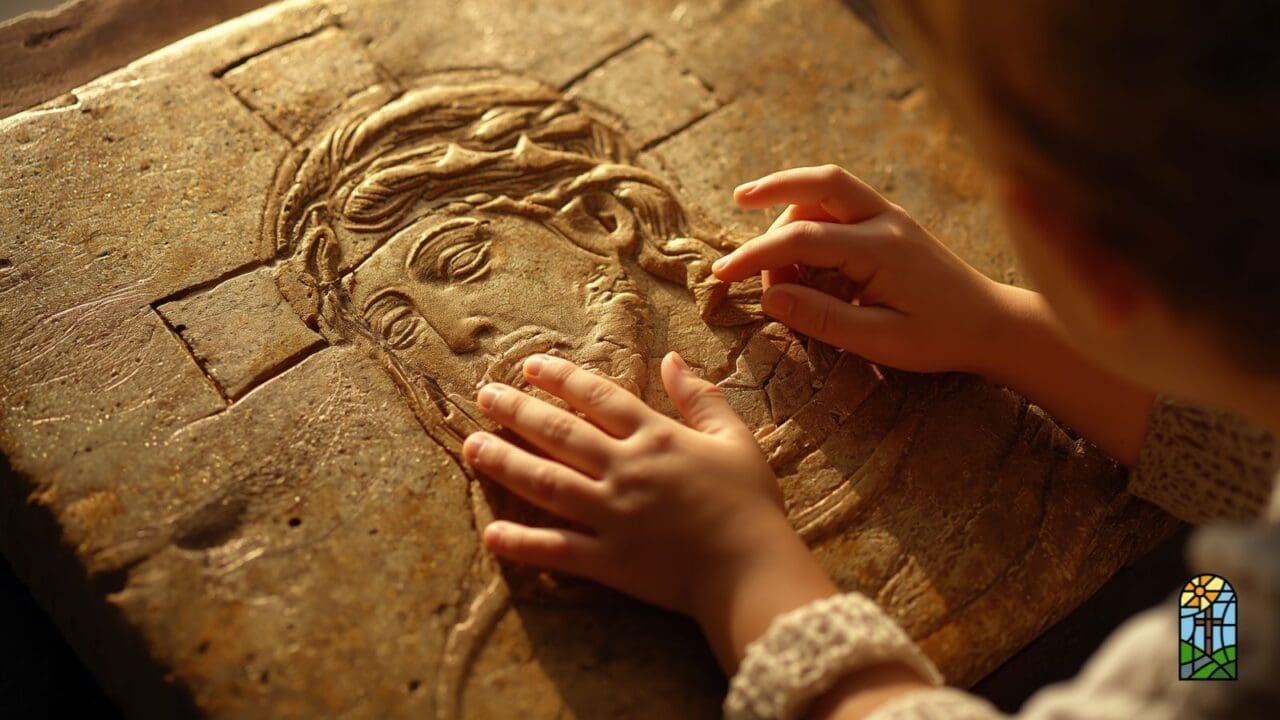
This idea of following Christ’s example, the word used here is hypogrammos. This is the only time this word shows up in the New Testament, and it literally describes a writing tablet students traced to learn their letters. Peter could have used any word for example or model. He chose this one.
What Peter is saying is that Christ is the pattern, and that we trace the shape of his life with our own.
Listen carefully. You’re not generating your own original response to suffering. You’re following the pattern that’s already been made.
There’s one more thing I want you to see to help understand this pattern.
In verse 23, Peter writes:
“When he was abused, he did not return abuse; when he suffered, he did not threaten; but he entrusted himself to the one who judges justly.”
The word I want you to see in there is paradidomi. It’s not a, “He was handed over.” It’s, “He handed Himself over.”
It’s a posture of deep trust in the God who judges justly.
isaiah 53 and the Shepherd
That line, and the rest of verses 22-25 there, are heavy in Isaiah 53 language. You could even say that Peter is making a theological argument that Jesus is the Suffering Servant that Isaiah foresaw.
And he carries it by suggesting that the people who follow Jesus are invited into that same servant identity.
Watch how Peter lands this idea, straight from the Isaiah 53 text.
“For you were going astray like sheep, but now you have returned to the shepherd and guardian of your souls.”
Psalm 23, which is also our Psalm for this week, has three movements worth naming here.
First, shepherd. “The Lord is my shepherd, I shall not want.”
Second, valley. “Even though I walk through the darkest valley… you are with me.”
And third, table. “You prepare a table before me in the presence of my enemies.”
Notice the posture shift. The Psalm begins talking about God. Then, when the valley comes, it shifts to talking to God. You are with me.
And where does it land? At the table.
Not a table of escape. A table of presence. In the middle of everything.
When we come to this altar during the Eucharist, we come bringing all of our brokenness, our suffering, everything we’re carrying. And we meet him there.
The one who was broken for us.
the third way
I love how Peter handles all of this.
He doesn’t deny or minimize the suffering. He also doesn’t baptize the unjust system that produces it, either.
Instead, he offers a third way. Endure it with dignity, trusting the outcome to a God who sees and judges justly, and recognize that Christ has already walked this exact path ahead of us.
We don’t need to make this up as we go. The pattern is already there. We’re merely tracing the lines that have already been laid down.
Tertullian, one of the early Church Fathers, wrote to Christians under Roman persecution around A.D. 200, and his words are worth hearing here. He writes about how Christians who are suffering unjustly aren’t losing. Rather, they’re bearing witness by a different set of rules than what the empire is playing by.
Almost 200 years after that, John Chrysostom preached a series on 1 Peter in which he leans into the charis language. He says that the Christian calculus of honor was genuinely inverted from the Roman world’s calculus.
In a culture where social shame was devastating, Chrysostom told his congregations in Antioch that what looks like humiliation from the outside is, in God’s economy, the location of real grace.
That was true in Antioch in the fourth century.
It was true for household servants in Asia Minor in the first.
And it’s true for us today.
So in just a few minutes, when we come forward to this altar, I want to invite you to bring it. Bring the thing that’s been done to you that wasn’t fair. Bring the promotion you deserved and didn’t get. Bring the relationship that ground you down. Bring the suffering that came not from your own choices but simply from trying to live with integrity in a world that doesn’t always reward that.
Bring it, and lay it down with the One who meets you here.
The One who was broken for us.
The Shepherd and Guardian of our souls.
Who has already walked every step of this path ahead of us.
By his wounds, you have been healed.

0 Comments