


I’ve been doing a lot of work at the intersection of AI and ministry lately. If you’ve read my book AI Systems for Churches, you know I’m not interested in using AI as a shortcut. I’m interested in using it as a tool that helps us go deeper, prepare more thoroughly, and engage more faithfully with our work. That conviction runs all the way through the book, and it especially shows up in the chapters on sermon and teaching preparation.
So it probably won’t surprise you to know that I eventually turned that same thinking into an AI Bible study tool I could package up and share.
I want to introduce you to the Exegesis Skill for Claude AI. It’s a structured biblical study framework I built for my own sermon and teaching prep, and then decided to make available to anyone else who might find it useful.
what this AI Bible study tool actually does
The Exegesis Skill is a Claude AI skill file that runs a full, eight-step exegetical process on any Scripture passage you hand it. It’s not a sermon generator. It’s not a devotional factory. It’s a serious AI Bible study tool that treats Scripture with the kind of careful, systematic attention it deserves.
Here’s what I mean by that. Exegesis, if you’re not familiar with the term, is the careful examination of a biblical text to get to the plain meaning of the text to its original audience, before you start drawing conclusions about what it means for us today. That involves examining the historical setting, the literary structure, the original language, and the broader theological themes at work. Done properly, it’s the kind of work that traditionally requires hours with commentaries, lexicons, and reference materials.
What this skill does is bring that same process into a focused, structured AI conversation, guided by a framework I’ve built and tested over time.
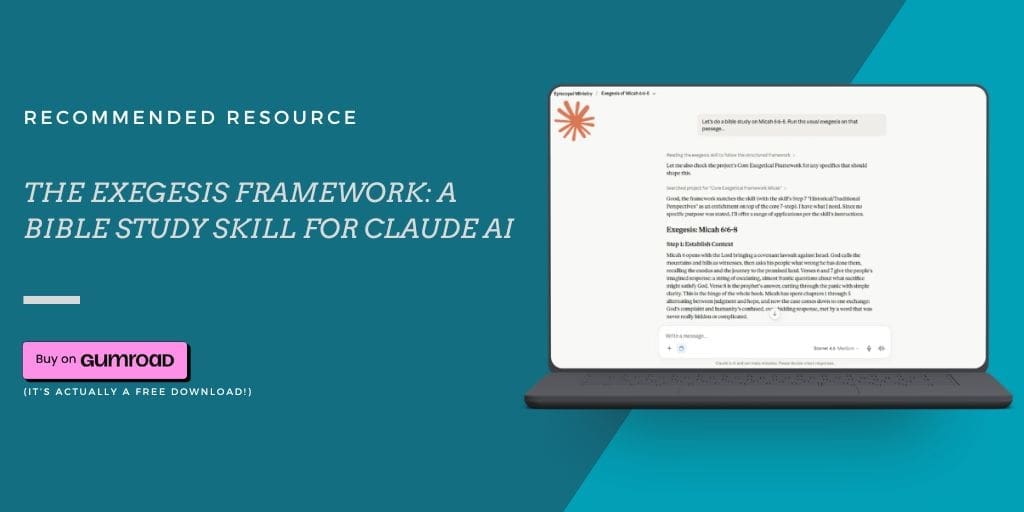
the eight steps
Every passage runs through all eight steps in order. No shortcuts.
Establish Context orients you within the book and the broader biblical story before you dig into any details. Historical Context explores the world of the text, the cultural, political, and social realities that shaped the author and the original audience. Literary Context reads the text on its own terms, paying attention to genre, structure, movement, and patterns.
From there, Key Words and Phrases examines several significant terms in the original Hebrew or Greek, with transliterations and notes on why they matter.
Theological Insights identifies what the passage reveals about God’s character and humanity’s condition, and connects it to overarching themes like covenant, redemption, and restoration. Canonical Connections situates the passage within the broader witness of Scripture… cross-references, typological connections, and New Testament fulfillment where it’s relevant.
Then comes Historical and Traditional Perspectives, which surveys how the church has read this text across 2,000 years, drawing from the Early Church Fathers, medieval interpreters, Reformation voices, Anglican divines, and modern scholars.
And finally, Summary Synthesis pulls it all together with the plain meaning of the text, a one-sentence Big Idea, two or three teaching or preaching angles, and practical applications shaped by whatever purpose you’re studying for.
the story that made me realize this was different
Let me tell you about a specific moment that changed how I thought about what this tool was actually capable of.
I was studying a passage in 1 Peter for a youth study… one of the sections that addresses instruction for wives. The historical context alone (understanding the dynamics of the time, place, and culture) was deeply informative and shaped the entire direction of our conversation. But it was the Historical and Traditional Perspectives step that really got my attention.
Most of the historical views the skill surfaced were where I expected them to land, given everything the historical and literary context had already established. But there was one… a perspective that went entirely against the grain. And my first instinct was to wonder why it was even there.
But then I sat with it. And I realized that’s exactly why it should be there.
In Episcopal and Anglican theology, we hold to what Richard Hooker called the three-legged stool: Scripture, tradition, and reason. The reason leg isn’t optional. It’s how we engage critically and thoughtfully with what we encounter in Scripture and tradition. And what this skill gave me was not just the views that supported a tidy conclusion, but the full range of how the church has wrestled with this text, including the voices that went a different direction.
That divergent perspective became one of the most valuable parts of our group study. We didn’t just accept it. We engaged with it. We talked about why we found it unconvincing, what it got wrong, where it misread the historical context. It became a real theological conversation, not just a confirmation of what we already believed.
That’s when I knew this was a genuine study resource and not just a tool that tells you what it thinks you want to hear.
it’s built in an episcopal/anglican framework… and that’s a feature
I want to be transparent about something. This skill was built within my own theological tradition. That means it carries certain instincts throughout… attentiveness to liturgy, an incarnational and sacramental theological sensibility, awareness of the Anglican divine tradition, and a pastoral tone that holds depth and warmth together.
It references voices like N.T. Wright, Rowan Williams, and Fleming Rutledge alongside Walter Brueggemann, Abraham Heschel, and the Church Fathers. The three-legged stool is embedded in how it approaches the tradition step. The whole thing is shaped by how I, as an ordained Deacon in the Episcopal Church, actually do the work of studying Scripture.
I think that’s a strength. Not a limitation.
But I also want to be clear: if you come from a different tradition, this is adaptable. A Reformed pastor can build in their confessional standards. A Wesleyan preacher can bring in the Wesleyan Quadrilateral. A pastor from a non-denominational background can define their own hermeneutical principles. The framework is the structure. You can adjust the theological instincts to match your context. The skill file is plain text, so there’s nothing opaque or locked down about it.
who it’s for
I built this for my own sermon preparation, and I still use it that way. But over time I’ve found it just as valuable in other contexts.
- If you’re a pastor or clergy person preparing to preach, it gives you a comprehensive exegetical foundation before you write a single word of your manuscript.
- If you’re a lay leader preparing an adult education class or a small group discussion, it gives you the kind of depth you might not have the time or training to reach on your own.
- If you’re a youth leader who wants to take a passage seriously without over-simplifying it, it helps you find the theological substance and then figure out how to translate it appropriately.
- And if you’re doing personal study (just you and a passage you want to understand better) it’s a remarkable conversation partner.
The skill also has optional extended layers you can activate: a mental health and pastoral care dimension that connects the text to anxiety, grief, lament, and healing; a youth ministry application layer with discussion questions and simple practices; and a liturgical and prayer connection that ties into the Book of Common Prayer, the Daily Office, and a brief closing prayer drawn from the text’s own language.
One more thing worth saying clearly: this isn’t a plug-and-play tool where you drop in a verse and get back a set of notes. It’s a conversation. Once the skill runs through the eight steps, you can keep talking. Push back on something that stood out to you. Bring in your own experience and understanding and see how it intersects with what the skill surfaced. Ask a follow-up question about a detail that caught your attention. Keep working through it until the passage actually opens up for you.
It’s not a static resource you read once and set aside. It’s dynamic. It helps you sort through the ideas, sit with the tensions, and keep digging until you get what you actually need from the Scripture you’re studying.
how to get it
The Exegesis Skill is available as a free download on my Gumroad. It’s a ZIP file that includes the SKILL.md file and a README that walks you through what it is, how to install it into a Claude project, and how to use it. You don’t have to pay anything for it, but if you find it valuable, tips are always welcome and genuinely appreciated.
If you haven’t read AI Systems for Churches yet, that book is the fuller context for all of this. Chapter 4 especially gets into how I think about AI-assisted exegesis and sermon preparation, and the principles in there shaped how I built this skill. The skill is a companion to that work… a practical, installable expression of what that chapter is pointing toward. And if you’re wondering what AI tools to use, check out… The AI Tech Stack That Can Transform Your Church’s Ministry (For About $31/Month).
This isn’t AI replacing the study. It’s AI making the study better. There’s a difference. And if you’ve been looking for a way to go deeper with Scripture preparation without spending hours you don’t have, I think this might be exactly what you’ve been looking for.
0 Comments