
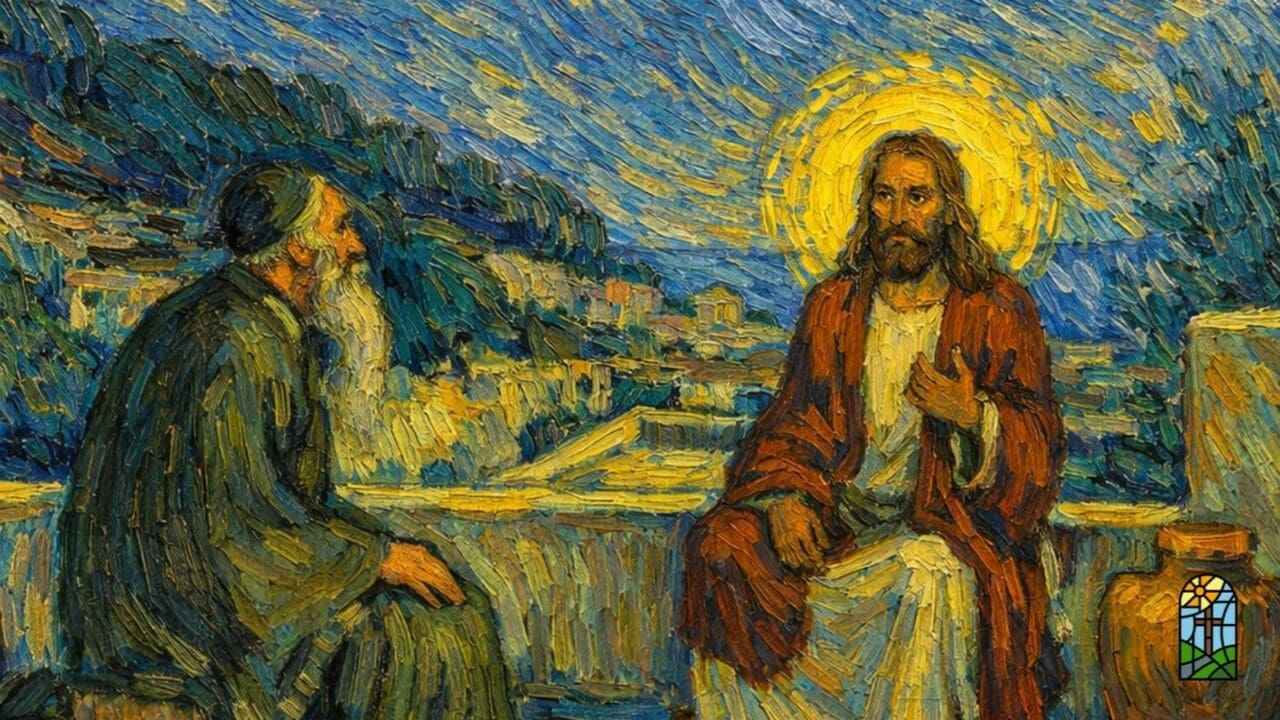

the reading:
There was a Pharisee named Nicodemus, a leader of the Jews. He came to Jesus by night and said to him, “Rabbi, we know that you are a teacher who has come from God; for no one can do these signs that you do apart from the presence of God.” Jesus answered him, “Very truly, I tell you, no one can see the kingdom of God without being born from above.” Nicodemus said to him, “How can anyone be born after having grown old? Can one enter a second time into the mother’s womb and be born?” Jesus answered, “Very truly, I tell you, no one can enter the kingdom of God without being born of water and Spirit. What is born of the flesh is flesh, and what is born of the Spirit is spirit. Do not be astonished that I said to you, ‘You must be born from above.’ The wind blows where it chooses, and you hear the sound of it, but you do not know where it comes from or where it goes. So it is with everyone who is born of the Spirit.” Nicodemus said to him, “How can these things be?” Jesus answered him, “Are you a teacher of Israel, and yet you do not understand these things?
“Very truly, I tell you, we speak of what we know and testify to what we have seen; yet you do not receive our testimony. If I have told you about earthly things and you do not believe, how can you believe if I tell you about heavenly things? No one has ascended into heaven except the one who descended from heaven, the Son of Man. And just as Moses lifted up the serpent in the wilderness, so must the Son of Man be lifted up, that whoever believes in him may have eternal life.
“For God so loved the world that he gave his only Son, so that everyone who believes in him may not perish but may have eternal life.
“Indeed, God did not send the Son into the world to condemn the world, but in order that the world might be saved through him.”
the sermon:
Have you ever believed in God… and still felt like you were standing in the dark?
Let’s be honest. God isn’t always easy to understand. Sometimes our struggle is simply understanding who He is. Or maybe we wrestle with those big questions like, “why does He allow suffering?”
Whatever the question, I’m willing to bet every one of us has wrestled with our faith.
And on the outside, we want to look like the happy, got-it-all-together Christians, while on the inside we’re not always sure… maybe even have doubts.
If that’s you, I’d like to introduce you to someone. His name is Nicodemus.
It’s in our Gospel reading from John 3 today where we first meet him. He’s a Pharisee, which means that he was a teacher and interpreter of the Law. He would have been trained in Torah and oral tradition and deeply immersed in Israel’s covenant story.
He would have been able to interpret and debate the Law. He wasn’t just educated. He was elite.
Yet, when he comes to talk to Jesus, he does so at night.
Why at night?
Maybe he didn’t want to be seen.
Maybe he wasn’t ready to commit publicly.
Or, maybe he’s still just sorting it all out.
Haven’t we all done that? We all have our own reasons why we often struggle with God…
We want control.
We want it to make sense.
We want theology that fits in neat categories.
We want answers for suffering.
We want God to behave predictably.
And when He doesn’t… we wrestle.
But Christianity has always wrestled with mystery. Think about ideas like the Trinity, or Incarnation, or the nature of Jesus, or Grace.
Some of the greatest minds in history have wrestled with these things, and often get to the point of just saying, “mystery.”
St. Augustine once said,
“If you comprehend it, it is not God.”
God is just so big that our finite minds cannot always comprehend it all.
The problem isn’t that there is mystery.
The problem is that we prefer mastery.
You don’t have to understand everything to step into the light.
I think that’s why Nicodemus resonates so deeply with me.
I am Nicodemus.
the nicodemus struggle
Unlike most of the other religious leaders of that time, Nicodemus isn’t a skeptic trying to trap Jesus. He’s trying to understand Him.
He believes that Jesus is from God. And he recognizes something divine in Jesus.
He’s not hostile or mocking. He’s actually sincere.
He says to Jesus,
“Rabbi, we know that you are a teacher who has come from God…”
That’s a respectful thing to say. But it’s also a safe thing to say.
He puts Jesus into a category… teacher, from God, sent. It’s all so manageable.
And then Jesus blows that category apart. He doesn’t say, “Thank you.” He says,
“no one can see the kingdom of God without being born from above.”
Look at what just happened here…
Nicodemus came looking for more information. He wanted clarification.
Jesus told him that he needed a new beginning. He demands transformation.
This unexpected direction threw Nicodemus into a mental tailspin. The confusion sets in, and he starts running away with questions…
“How can anyone be born after having grown old? Can one enter a second time into the mother’s womb and be born?”
This whole idea of “new birth” was destabilizing for Nicodemus, because…
You can’t engineer it.
You can’t optimize it.
You can’t earn it.
You can’t control it.
For someone who’s whole life was built around keeping and teaching adherence to Torah, this goes against everything he’d ever learned and knew about God.
And it’s that same thing that unsettles us, even today.
We want a faith that makes sense.
We want doctrines we can diagram.
We want suffering explained.
We want God predictable.
In our reading today, we don’t even see Nicodemus getting it yet. He’s struggling with accepting these Truths. The last thing we hear from him in this passage is,
“How can these things be?”
Nicodemus doesn’t get it that night. But that’s not the end of his story.
the long arc: from night to the Cross
And here’s what I love about John’s Gospel. This isn’t the last time we see Nicodemus.
There are three times when we see Nicodemus explicitly named in the Scriptures. But make no mistake. He was close to everything that was going on.
As a Pharisee and ruler of the Jews, he would have been part of the leadership circle that debated Jesus. He would have known the concerns, heard the accusations, and felt the tension.
Anywhere in the Gospels when we see the Pharisees involved, even if he wasn’t specifically there, he likely would have known about what was happening.
And the second time we see his name pop up, he’s with a group of the Pharisees. In John 7, there’s a story about the temple police being asked by the Pharisees about their failure to arrest Jesus.
The religious leaders want Jesus arrested. And in that interaction, Nicodemus speaks up. Not boldly or dramatically. But almost in a meek little way that makes a way to hear more from Jesus himself. He says,
“Our law does not judge people without first giving them a hearing to find out what they are doing, does it?”
He’s not confessing what he believes about Jesus. Rather he creates space to talk about it.
Sometimes faith begins not with a declaration, but with a question.
Then comes the response from the other Pharisees. He’s mocked by them, likely to just shut him up… “Aren’t you from Galilee too?”
Later in John 19, we get the story of the Crucifixion. Jesus is dead. The disciples have scattered.
And Nicodemus shows up again. Verse 39 reads,
“Nicodemus, who had first come to Jesus by night, also came, bringing a mixture of myrrh and aloes, weighing about a hundred pounds.”
This act… it was expensive, public, risky, and highly devotional.
The man who first came in the dark of night, now stands at the Cross in full daylight.
John never tells us what Nicodemus believed. But he showed us where he stood.
There’s an old saying,
“We are not made whole all at once, but little by little.”
Nicodemus moved from night, to caution, to costly devotion in full daylight.
And all of this is building toward something that Jesus says in that first conversation, a sentence we all already know.
John 3:16.
for God so loved the world
We’ve seen the struggle. We’ve watched Nicodemus wrestle. And we’ve followed him from questions in the night to standing at the foot of the cross in the daylight. And now Jesus speaks to the heart of it all.
“For God so loved the world that he gave his only Son, so that everyone who believes in him may not perish but may have eternal life.”
It’s not “God tolerated.”
It’s not “God corrected.”
And it’s not “God analyzed.”
God loved.
This is God initiating.
Nicodemus came at night with his questions. But God was already moving toward him.
Listen carefully. Before you figured it out, before you solved your theology, before you resolved your doubts… God loved.
Who did God love? The world. In the original Greek, John used the word kosmos, a term he used somewhere around 78 times in his Gospel.
In John’s Gospel, kosmos often describes a world that misunderstands Him, resists Him, even rejects Him. It’s not just the people who get it right. It’s the people who don’t.
If you were Nicodemus, a Pharisee, a teacher of Israel, you would expect, “For God so loved Israel…” or maybe “For God so loved the righteous…”
But Jesus said, kosmos.
That includes Romans and pagans.
Skeptics and religious elites.
Those who misunderstand Him.
Even those who crucify Him.
God’s love isn’t triggered by your understanding, it precedes and surpasses it.
The God who called creation good knew what it would cost Him to redeem it. And still, He created. And still, He loved.
So the Word who spoke galaxies into existence gave Himself over to the nails in order to make a way for us.
And Jesus says…”That whoever believes…”
This isn’t an intellectual agreement. It’s trust. It’s stepping into light.
Belief, in John’s Gospel, isn’t nodding your head. It’s leaning your weight onto Him.
Like Nicodemus, it’s moving from night to daylight.
You don’t have to understand everything to step into the light.
not a slogan… a rescue
Nicodemus didn’t walk away from that conversation with everything figured out.
He still had questions.
He still had tension.
He still didn’t fully understand how this “new birth” thing worked.
But somewhere between that conversation at night and the foot of the cross in the daylight… something shifted.
He moved.
He didn’t master the mystery.
He stepped into it.
And that’s the invitation for us.
John 3:16 isn’t a slogan.
It’s not just something we put on signs or memorize as children.
It’s the announcement that the God who made the world loves the world.
Not the polished version of it.
Not the cleaned-up version of it.
The real one.
The confused one.
The doubting one.
The broken one.
The one that still comes at night.
It’s the declaration that before you solved your theology, before you reconciled your questions, before you untangled your doubts… God loves you.
And He gave His Son.
You don’t have to understand everything to step into the light.
You don’t have to resolve every tension before you trust Him.
Faith is not mastery. It’s movement. It’s turning your face toward the One who already turned His toward you.
And that is the hope of the Gospel.
Not that we have figured Him out, but that we are known and loved.
And that love is enough to bring us from the dark into the light.
Even when we don’t yet understand it.
Amen.


0 Comments