


For years I’ve run a Summer Bible reading challenge with our youth group. It started simple — a printed flyer, a few reading plans, and the honor system. Kids would keep a log, get it signed by an adult witness, and show up to the first youth group meeting of the school year hoping for extra ice cream toppings.
It worked. Sort of.
The honest truth is that some kids would come back in September having genuinely dug into the Word all summer. Others… not so much. And I never really had a way to know who was engaged, who needed encouragement, or who had totally fallen off by the second week of June.
That’s been gnawing at me for a while now, because reading and studying the Bible is a truly transformative experience. So this summer, I finally did something about it.
The Problem with Summer Bible Reading for Youth
Summer is genuinely hard for keeping youth engaged spiritually. There’s no regular gathering. No built-in accountability. No social thread connecting them to each other or to their faith community. School provides structure, youth group provides community, and summer quietly strips both away.
And teenagers are wired for social connection. They don’t do things in isolation — they do things together. They want to know how their friends are doing, whether they’re keeping up, whether they’re winning. That’s not a flaw. That’s just how they’re built.
The other challenge is that a printed flyer and an honor system only goes so far. There’s no momentum to it. No sense of progress. No moment where a kid feels the satisfaction of checking something off and watching a streak grow.
So I started thinking about what would actually work. And the answer turned out to be something we already had in our pockets.
What Actually Keeps Teenagers Engaged
If you’ve ever watched a teenager with a game on their phone, you already know the answer. It’s not complexity. It’s not difficulty. It’s the combination of three simple things:
A clear goal. They know exactly what they’re working toward. The finish line is visible.
A sense of progress. Every action moves the needle. They can see how far they’ve come.
Social stakes. Other people can see how they’re doing. There’s friendly competition. There’s community.
Bible apps already exist, of course. But most of them are built for solo devotional use, not for a youth group doing a challenge together. And none of them were built with the specific reading plans I wanted to use, the group dynamic I was trying to create, or the Episcopal tradition I wanted to honor (not that you have to be Episcopalian to use this, it works for any denomination).
So I built one.
Introducing The Dig

The Dig is a free Bible reading challenge tracker I built specifically for this. It’s a web app — meaning it works on any phone or device without needing to download anything from an app store (but you can “Save to Home” screen so that it functions just like any other app). You just go to thedig.bibledude.life, create an account, and you’re in.
Here’s how it works.
Pick Your Challenge
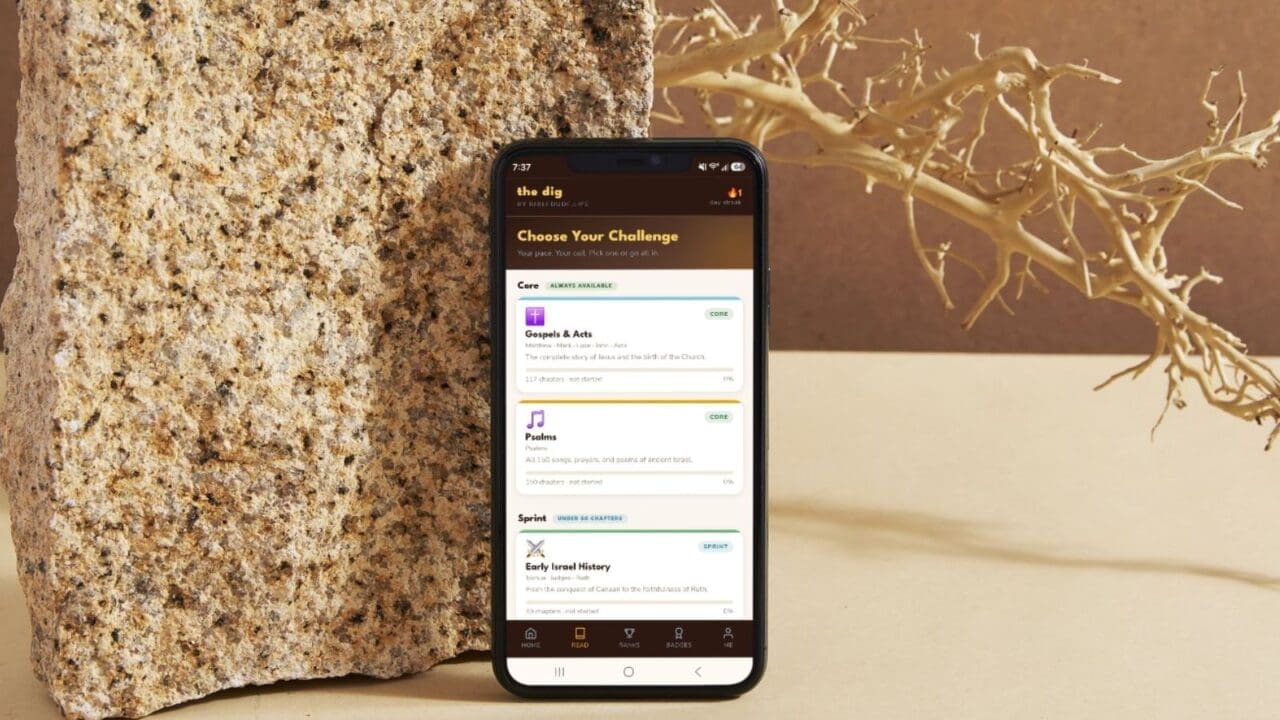
Right now The Dig is running a Summer Challenge with seven different reading plans to choose from:
Core Challenges (always available):
- Gospels & Acts — All four Gospels and the Book of Acts. 117 chapters covering the complete story of Jesus and the birth of the Church.
- Psalms — All 150 songs, prayers, and poems of ancient Israel.
Sprint Challenges (under 50 chapters):
- Early Israel History — Joshua, Judges, and Ruth. 49 chapters of conquest, faithfulness, and some genuinely wild stories.
- Exile & Return — Ezra, Nehemiah, and Esther. 33 chapters about God’s faithfulness in the darkest season of Israel’s history.
Challenge Tier (50-90 chapters):
- Minor Prophets — All twelve minor prophets, Hosea through Malachi. 67 chapters of voices calling people back to God.
- John’s World — The Gospel of John, 1-3 John, and the complete book of Revelation. 50 chapters of the theology of love and the end of all things.
- Paul’s Letters — Romans through Philemon. 87 chapters of the theological backbone of the New Testament.
Kids can pick one challenge or tackle multiple at the same time. It’s completely at their own pace — there’s no “daily reading” assigned, no missed days, no guilt. If you want to read ten chapters of Psalms today and nothing tomorrow, go for it.
Log It, Track It

When you open a challenge you see each book broken out with its individual chapters. Tap a chapter to log it. It turns green with a checkmark. Tap again to unlog it if you made a mistake.
That’s genuinely it. The simplicity is intentional. The friction has to be low enough that a teenager will actually do it before they put their phone down.
As you log chapters, your progress bar fills up. Your total chapter count climbs. And your streak grows every day you log at least one chapter in any challenge.
The Leaderboard

Here’s where it gets social.
Every reader on The Dig shows up on a global leaderboard, ranked by total chapters logged. Your youth group kids can see exactly where they stand against each other — and against kids from other churches doing the same challenges.
If your church has a group subscription (more on that in a minute), your kids also get a private leaderboard showing just your church group. That local competition is often more motivating than the global one — they know these people, they sit next to them at youth group, and they very much want to be ahead of them.
Badges

On top of the leaderboard there’s a badge system. Badges are awarded for things like:
- Logging your first chapter ever
- Hitting 7, 30, and 60 active days
- Completing a specific challenge (each one has its own badge)
- Reading 50, 100, 200, and 500 total chapters
- Completing multiple challenges in one season
Locked badges show up greyed out so kids can see what they’re working toward. That visible locked badge is sometimes more motivating than the one they’ve already earned.
The Covenant
One thing that was important to me from the start was integrity. It’s an honor system — there’s no way to verify that someone actually read what they logged. But there’s a moment before you ever check off your first chapter where you’re asked to sign your name to a simple commitment:
“This challenge runs on honesty. No one’s checking your work — that’s between you and God. By signing below, you commit to only logging what you’ve actually read.”
It’s not a lock. But it’s a moment of intention. And for most teenagers, that moment matters more than we give them credit for.
Free for Individuals, Affordable for Groups
The Dig is completely free for individual readers. Anyone can go to thedig.bibledude.life, create an account, pick a challenge, and start logging. No credit card, no trial period, no catch.
For youth directors who want a private group leaderboard for their kids, a Church Group subscription is $30/year. That gets you a custom group code you share with your youth, a private parish leaderboard showing only your group, and a director dashboard to see who’s engaged. For a church budget, that’s less than a pizza party — and it’ll get you a lot more engagement than one.
Beyond Summer
The Summer Challenge is live right now, but The Dig isn’t going away in September. The plan is to run seasonal challenges throughout the year — an Advent reading challenge, a Lenten challenge, and others as the church calendar moves. The reading plans will rotate so there’s always something fresh to dig into, and the leaderboard and badge system carry over so the momentum you build this summer doesn’t disappear.
Get Your Youth Digging
If you’re a youth minister, here’s what I’d encourage you to do:
- Go try it yourself first — thedig.bibledude.life. Sign up, pick a challenge, log a few chapters. Get a feel for it.
- If it resonates, grab a group subscription and share the group code with your kids before summer gets going.
- Mention it at your last youth group meeting before summer break. Make it a challenge. Tell them the leaderboard is live and you’re watching.
And if you’re a parent reading this — send the link to your teenager. You don’t have to pitch it hard. Just drop it in a text. “Hey, this looks kind of cool.” That’s enough.
The Word is worth digging into. And if a little friendly competition and a streak counter is what gets a teenager to open their Bible this summer, I’m completely okay with that.
Start your challenge at thedig.bibledude.life.
The Dig is a free tool built by BibleDude.life. Church Group subscriptions are $30/year. Questions? Reach out to me here.

0 Comments